
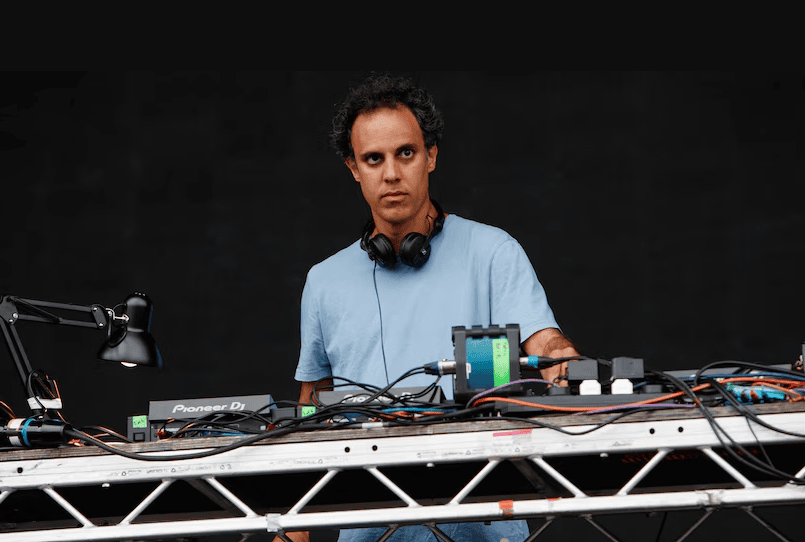
There are DJ sets that disappear the moment the lights come up, and there are those that become part of an artist’s mythology. Four Tet’s performance at London’s Alexandra Palace on November 22, 2025 belongs firmly to the latter category. Nearly a year after the night unfolded, the complete recording has emerged on Apple Music, transforming a landmark hometown performance into something more permanent: an audio document of Four Tet at full creative stretch.
For an artist whose influence has always extended beyond conventional genre boundaries, the significance of the release lies in its completeness. Rather than offering a highlights reel or a condensed festival edit, the recording preserves the full journey — the patient transitions, unexpected turns, euphoric peaks and deeper club moments that define a Four Tet DJ set.
Alexandra Palace Becomes Part of the Four Tet Story
Few venues carry the same weight in London’s live-music landscape as Alexandra Palace. The sprawling North London landmark has hosted generations of artists and audiences, but electronic music has given the space a particularly powerful second life, turning its enormous interiors into a meeting point between club culture and large-scale live performance.
For Four Tet, playing there was more than another date on a touring schedule. London has been central to his artistic identity from the beginning, and the city’s experimental electronic community has long provided the environment in which his sound developed.
That relationship between place and music is important here. Four Tet has never been an artist easily contained by the traditional boundaries of dance music. His work moves fluidly between house, techno, UK garage, jungle, ambient textures, broken rhythms and experimental electronics. His DJ sets operate in much the same way — less like a sequence of tracks and more like a constantly shifting conversation between scenes, eras and emotions.
The Alexandra Palace recording captures that philosophy at scale.
57 Tracks, One Continuous Narrative
The 57-track tracklist offers a revealing snapshot of Four Tet’s musical universe. His own productions sit alongside collaborations, remixes, edits and selections drawn from the wider underground — creating the kind of deliberately unpredictable ecosystem that has become synonymous with his performances.
Among the recognisable moments are “Parallel 1” and “You Are Loved”, while his collaboration with Burial on “Nova” adds another layer of UK electronic-music history to the set. A remix of PinkPantheress’ “Illegal” demonstrates Four Tet’s continuing ability to pull contemporary pop into an underground framework, while his reworking of Eric Prydz’s “Opus” shows how comfortably he can reinterpret a track associated with a very different corner of dance music.
Skrillex also enters the story through “Talk To Me”, reinforcing the creative relationship between two artists who have repeatedly demonstrated how porous the boundaries of modern electronic music have become.
But perhaps the more revealing aspect of the tracklist is what surrounds those familiar names.
KH edits, material associated with Special Request and Floating Points, Aril Brikha selections and cuts from Bruce create a much broader picture. Jungle, techno, house and left-field club music coexist without being forced into a single stylistic category.
That is where the real Four Tet signature emerges.
The Art of the Unexpected
Four Tet’s reputation has never depended solely on producing tracks that work inside a club. His greater contribution has been his ability to connect seemingly incompatible musical worlds without making the collision feel artificial.
A Four Tet set can move from a familiar anthem into something obscure enough to send listeners searching for its origins afterwards. A peak-time moment can suddenly give way to a strange rhythmic detour, only for the room to discover that the detour was precisely what it needed.
In an era where DJ culture is increasingly shaped by algorithms, short-form clips and instantly recognisable drops, that kind of unpredictability has become almost radical.
The Alexandra Palace recording therefore works as more than a live album. It is a reminder of what a DJ set can still be when it is allowed to unfold as a long-form piece of musical storytelling.
The 57 selections are not simply a catalogue of tracks played on one night. Together, they document the logic — or apparent lack of logic — behind Four Tet’s musical instincts.
From Underground Credibility to Global Influence
Few electronic artists have managed to maintain underground credibility while becoming a genuine crossover force in the way Four Tet has.
His career has been built around curiosity rather than formula. He has collaborated with artists from across the electronic spectrum, appeared in unexpected cultural spaces and continually resisted the pressure to settle into one commercially recognisable sound.
That makes the Alexandra Palace set particularly valuable as an archival piece.
It arrives during another significant period in Four Tet’s career, following his surprise Wingdings project and high-profile appearances that have continued to place him at the intersection of experimental electronic music and the global festival circuit.
Yet the appeal of this recording is not necessarily tied to career milestones. Its value is more immediate: it allows listeners who were not inside Alexandra Palace that night to experience the architecture of the performance for themselves.
And for those who were there, it offers something equally important — a way back.
Why Full-Length DJ Sets Still Matter
The growing availability of complete DJ sets is quietly changing how electronic music is documented.
For decades, much of club culture existed in a state of impermanence. A great set happened once, was experienced by the people in the room and then survived only through memory, bootlegs or fragments uploaded years later. Modern streaming platforms have changed that relationship, giving artists and audiences new ways to preserve moments that once would have vanished.
Apple Music’s growing role in electronic music and DJ mixes reflects this broader shift. Full-length recordings provide context that individual tracks cannot. They allow listeners to understand pacing, sequencing and atmosphere — the elements that distinguish DJing as an art form from simply playing a collection of songs.
Four Tet is particularly suited to this format because his sets reward patience.
A two-minute clip might capture the explosion. A full recording captures everything that made the explosion meaningful.
A London Night Preserved in Sound
The most compelling thing about the Alexandra Palace recording is ultimately its sense of place. It documents an artist deeply connected to London, performing for a hometown crowd in one of the city’s most recognisable spaces, while drawing from a musical vocabulary that stretches far beyond any single scene.
That tension — local identity against global influence — has always been central to Four Tet’s appeal.
He can make an enormous room feel intimate, pull obscure club records into conversations with mainstream electronic music and turn a DJ booth into a space for genuine musical discovery.
Now, that November night no longer exists only in the memories of the people who experienced it.
It exists as a complete piece of electronic-music history.
And perhaps that is the most fitting way to preserve a Four Tet set: not as a collection of peak moments, but as an entire journey. In a culture increasingly obsessed with the instant, Four Tet’s Alexandra Palace recording makes the case for staying with the music long enough to see where it takes you.








Comments are closed.